Eastern Orthodox Christianity in Malta – List of All Orthodox Churches
Eastern Orthodox Christianity in Malta
A Complete Guide to History, Churches & Communities
Table of Contents
Introduction: What Is Eastern Orthodoxy?
If you have ever wandered through the sun-drenched streets of Valletta and spotted a gilded icon through a half-open door, or heard the deep resonance of Byzantine chant drifting from a centuries-old church, you may have brushed shoulders with Eastern Orthodoxy — one of the world’s oldest and most spiritually rich Christian traditions.
Eastern Orthodox Christianity is the second-largest Christian denomination in the world, with roughly 300 million believers stretching from Greece and Romania to Russia, Serbia, Ukraine, and beyond. It traces a continuous, unbroken line back to the original Church founded by Jesus Christ and the Apostles, and it parted ways with Western (Roman Catholic) Christianity in the Great Schism of 1054.
Orthodox Christianity is characterised by its ancient liturgical worship, the veneration of icons (sacred images), the use of incense and candles, services conducted largely in traditional languages, and a profound theology of theosis — the idea that human beings are called to participate in the divine life of God. For many of its adherents, Orthodoxy is not just a religion but a whole way of life rooted in centuries of tradition, art, and sacred music.
“Malta may be a deeply Catholic island, but its story of Eastern Orthodoxy stretches back over a thousand years — to the very first Christian communities that arrived with the Byzantine Empire.”
The Deep Roots: Orthodox Malta Before 1054
Long before the Great Schism divided Eastern and Western Christendom, Malta was already part of the Byzantine world. From roughly the mid-8th century onwards, the Church in Malta fell under the authority of the Byzantine Patriarchate of Constantinople. This was not a matter of geography alone — it reflected Malta’s cultural, linguistic, and ecclesiastical ties with the Greek-speaking Eastern Roman (Byzantine) Empire, which at that time controlled the central Mediterranean.
The Arab invasion of Malta in 869 AD brought this Byzantine chapter to a dramatic close. The Muslim Aghlabids conquered the islands and effectively severed Malta’s connection with the Christian world for the best part of three centuries. Yet history has a way of preserving its secrets: when the Norman King Roger II invaded and recaptured Malta in 1127, he reportedly found an existing Christian community on the smaller island of Gozo — a community that had somehow survived under Arab rule, complete with its own bishop.
That resilient community in Gozo is one of the most fascinating details in Maltese religious history. It suggests that even during the long period of Muslim rule, the thread of Byzantine-rite Christianity was never entirely broken. When the Normans arrived, they found evidence of a Greek hierarchy, Greek parishes, and a living Christian community — a living relic of the Byzantine Church in the heart of the Mediterranean.
From the 12th to the 15th century, documentary evidence confirms a continuing Greek Christian presence on the Maltese islands. A certain Nikolaos, who carried the title of Protopapas (a rank equivalent to a bishop’s deputy in the Byzantine system of the era), is recorded as an active church leader in Malta during the 12th and 13th centuries. His title strongly implies the existence of an organised Greek hierarchy, a Greek-speaking Christian community, and an established parish structure during this period.
The Knights of St John and the Greek Diaspora (1530–1800)
The arrival of the Knights of St John (the Hospitallers) in Malta in 1530 marked the beginning of a new chapter for Orthodox Christianity on the island. The Knights were a Roman Catholic military and religious order, and they quickly imposed Latin Christianity as the dominant religion. Nevertheless, Malta’s strategic position in the Mediterranean made it a crossroads for merchants, refugees, and diplomats from across the Greek world — many of whom brought their Orthodox faith with them.
Greek merchants, sailors, and craftsmen settled in Valletta, the Knights’ newly founded capital city, and they brought with them the Eastern Orthodox tradition they had practised for generations. The result was a small but tenacious Greek Orthodox community that would leave its mark on the island’s religious landscape for centuries to come.
One of the most visible legacies of this era is the Church of St Nicholas — built in 1569 specifically to serve the Greek Orthodox community in Malta. It is one of the oldest Eastern Orthodox churches in Western Europe still in active use. The Church of St George followed in 1816, also serving the Greek Orthodox community under the authority of the Ecumenical Patriarch of Constantinople.
The story of these churches is not without tension. In 1639, the parish priest of St Nicholas, Papas Giovanni Metaxi, joined the Greek Catholic Church — that is, he accepted the authority of the Pope in Rome while retaining the Byzantine rite. This conversion led the church to be handed over to the Confraternity of the Souls in Purgatory, a Roman Catholic organisation, and it was completely rebuilt in the Baroque style in 1652 by Italian architect Francesco Buonamici. For nearly four centuries, the church remained in Catholic hands, though it was eventually returned to the Greek Orthodox community and is now under the jurisdiction of the Ecumenical Patriarchate of Constantinople.
The 20th Century and the Growth of Orthodoxy
The 20th century brought dramatic changes to Malta’s Orthodox communities. The Second World War was particularly destructive: Valletta was one of the most heavily bombed cities in all of Europe, and its churches did not escape. The Church of St Nicholas suffered severe damage during aerial bombardment, and the Church of Our Lady of Damascus was completely destroyed in a bombing raid on 24 March 1942. Both were eventually restored — St Nicholas by 1951, and Our Lady of Damascus rebuilt and reconsecrated the same year.
The post-war period and, especially, the later decades of the 20th and early 21st centuries saw a remarkable surge in Malta’s Orthodox population. This growth was driven primarily by immigration. As Malta became an increasingly attractive destination for workers from Eastern Europe and the former Soviet Union — particularly from Romania, Serbia, Russia, Ukraine, Bulgaria, Georgia, and Belarus — the Orthodox faithful on the island multiplied rapidly.
The 2014 Maltese census recorded at least 5,000 Orthodox believers, representing about 1.2% of the population. By the 2021 census, that number had grown to an astonishing 16,457 — a more than three-fold increase in just seven years. Today, Orthodox Christianity is by far the largest non-Catholic Christian denomination in Malta, and the island is home to several vibrant communities from different national Orthodox traditions.
By 2021, Malta was home to 16,457 Eastern Orthodox believers — a community that has grown dramatically in the 21st century, driven by immigration from Eastern Europe.
A New Era: The Holy Patriarchal Exarchate of Malta (2021)
A landmark moment in the history of Orthodoxy in Malta came on 14 January 2021, when the Holy Synod of the Ecumenical Patriarchate of Constantinople formally established the Holy Patriarchal Exarchate of Malta as a separate ecclesiastical jurisdiction. Previously, the Greek Orthodox community in Malta had been administered as part of the larger Orthodox Archdiocese of Italy and Malta. The creation of a dedicated Exarchate for Malta — the first of its kind — reflected the growing Orthodox population on the islands and the desire to provide more focused spiritual care for the faithful.
His Eminence Kyrillos Katerelos, Metropolitan Bishop of Krini, was appointed as the first Patriarchal Exarch of Malta, taking up his role with responsibility for the spiritual and canonical oversight of all parishes under the Ecumenical Patriarchate on the island.
A further historic milestone came in December 2022, when His All-Holiness Bartholomew I, the Ecumenical Patriarch of Constantinople, made an official visit to Malta — the first ever such visit by a reigning Ecumenical Patriarch. During his visit, Patriarch Bartholomew presided over Great Vespers for the Feast of Saint Nicholas at the Church of St Nicholas in Valletta. He also met with Malta’s President George Vella and Foreign Minister Ian Borg to discuss interreligious dialogue and the situation of the Orthodox diaspora in the Mediterranean.
Directory of Orthodox Churches in Malta
Today, Malta is home to several active Orthodox communities, each with its own national tradition, parish church or shared worship space, and schedule of services. Below is a comprehensive guide to each one.
1. Church of St Nicholas — Valletta
Greek & Ukrainian Orthodox | Holy Patriarchal Exarchate of Constantinople
The Church of St Nicholas is the oldest and most historically significant Orthodox church in Malta. Its roots go back to 1569, when it was built to serve the Greek Orthodox community under the Knights of St John. It is, in every sense, the mother church of Orthodoxy in Malta.
Although the church passed out of Orthodox hands in 1639 and was extensively rebuilt in 1652 in the Baroque style, it was formally returned to the Greek community in 2014 and subsequently entrusted to the Ecumenical Patriarchate of Constantinople. Today it serves both a Greek Orthodox parish and a Ukrainian Orthodox parish, both of which share the building and collaborate in worship.
The church is a beautiful example of Maltese Baroque architecture. Its facade is divided into three bays at ground level with a single central bay above. Inside, the church follows a Greek cross floor plan, with a central dome supported by four free-standing columns. A large stone statue of St Nicholas graces the facade. The church’s titular painting is by Mattia Preti, the celebrated Calabrian artist who spent decades in Malta.
| 📍 Address | Merchants Street, Valletta, Malta |
| 🕐 Saturday | Vespers at 18:00 (6:00 PM) |
| 🕐 Sunday | Orthros at 09:00, Divine Liturgy at 10:00 |
| 📜 Parish | Greek Orthodox Parish & Ukrainian Orthodox Parish of St Nicholas |
| 🌐 Jurisdiction | Holy Patriarchal Exarchate of Malta (Ecumenical Patriarchate of Constantinople) |
| 👤 Exarch | Metropolitan Kyrillos Katerelos |
| 🌐 Website | www.exarmalta.com |
2. Church of St George — Valletta
Greek Orthodox | Ecumenical Patriarchate of Constantinople
The Church of St George is a smaller, more intimate Greek Orthodox church tucked into the heart of Valletta on Merchants Street — just steps away from the Church of St Nicholas. It was founded in 1816 by the Greek community living in Malta, and it too falls under the canonical authority of the Ecumenical Patriarch of Constantinople.
The Church of St George is a historic and beloved landmark for the Greek community in Malta. Its records of baptisms, marriages, and deaths spanning generations of the Greek diaspora in Malta are preserved in the archives of the Mdina Cathedral museum — a remarkable resource for those tracing Greek Maltese heritage.
Today, services at St George are held on a monthly basis (the last Sunday of each month), with regular weekly services conducted at the nearby Church of St Nicholas. The two churches together form the heart of Greek Orthodox life in Valletta.
| 📍 Address | 83 Merchants Street, Valletta, VLT 1177, Malta |
| 🕐 Services | Last Sunday of each month |
| 📜 Founded | 1816, by the Greek community of Malta |
| 🌐 Jurisdiction | Orthodox Archdiocese of Italy & Malta / Holy Patriarchal Exarchate of Malta |
| 👤 Priest | Archimandrite Niko Gongadze |
3. Church of St Roque (Romanian Orthodox Parish) — Valletta
Romanian Orthodox | Romanian Orthodox Diocese of Italy
Of all the Orthodox communities in Malta, the Romanian Orthodox community is among the most active and fastest-growing. Romania is the largest Orthodox country in the European Union, and Romanian immigration to Malta in the 2000s and 2010s brought thousands of devout Orthodox faithful to the island. Today, there are an estimated 2,000 Romanians and 500 Moldovans — who share the Romanian language and Orthodox tradition — living in Malta.
The Romanian Orthodox Parish in Malta is formally dedicated to the Nativity of Saint John the Baptist and was officially established on 7 April 2014, with the blessing of His Grace Bishop Siluan of Italy and Malta. The parish is part of the Romanian Orthodox Diocese of Italy, which in turn is a diocese of the Romanian Orthodox Patriarchate — one of the nine patriarchates of the Eastern Orthodox Church.
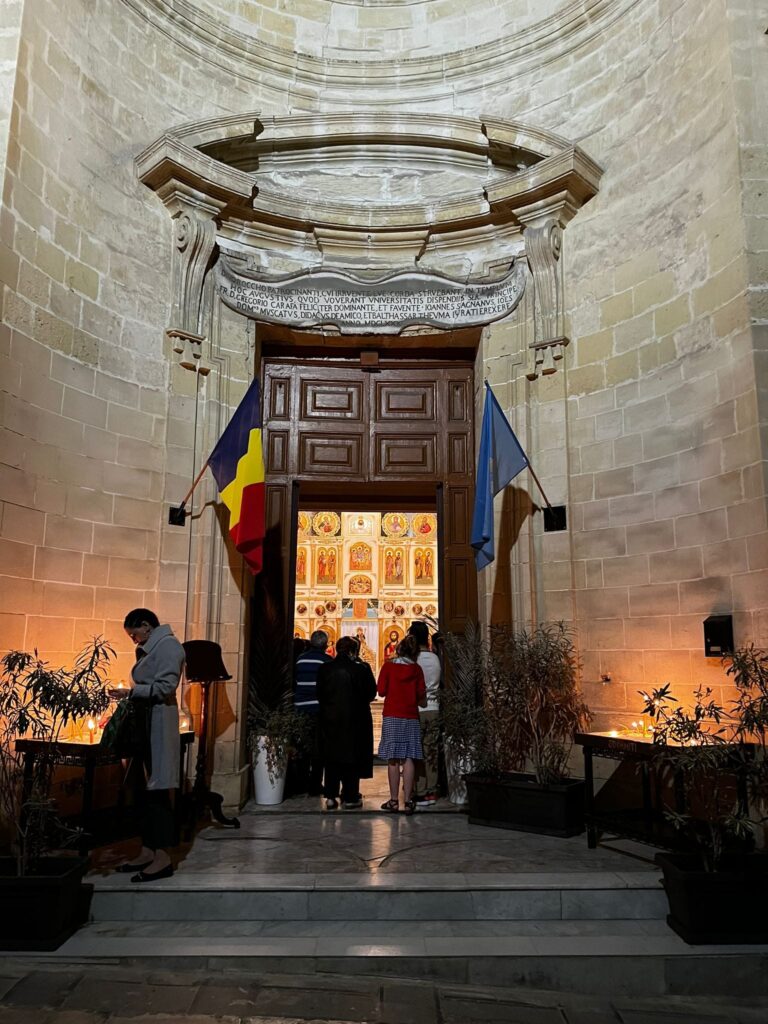
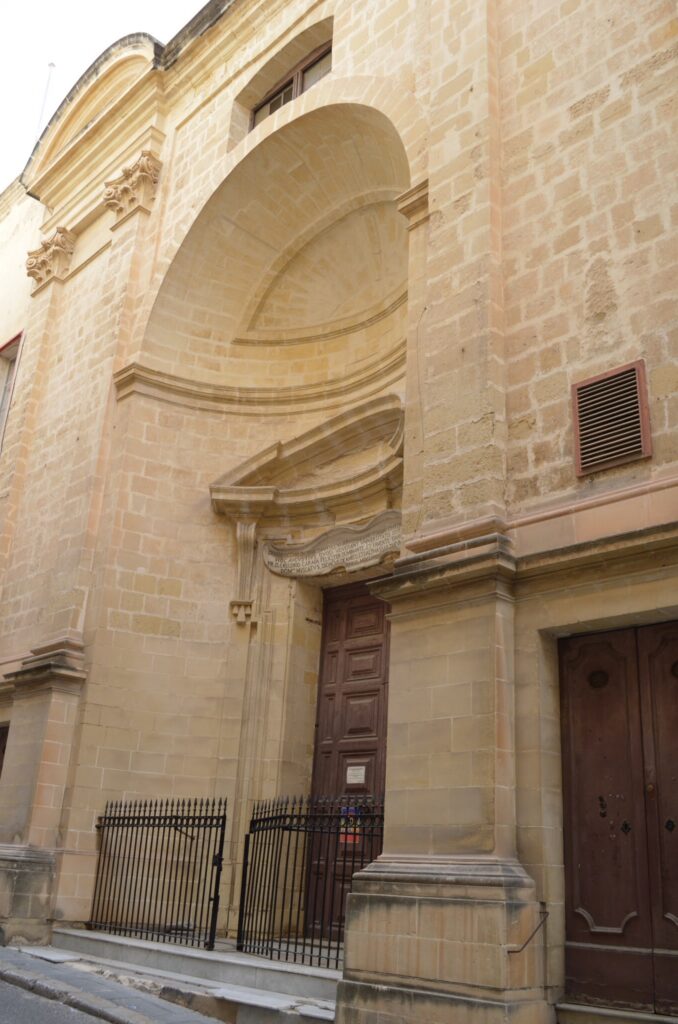
The parish worships at the Church of St Roque (in Maltese: Knisja ta’ San Rokku), a beautiful 17th-century Baroque church located on St Ursula Street in Valletta. The church was originally built by the Catholic community in fulfilment of a vow made during the devastating plague of 1593. It was enlarged after the plague of 1676, with work commencing in 1680 under the supervision of renowned Maltese architect Lorenzo Gafa, and was blessed on 12 August 1681. The church remains officially owned by the Roman Catholic Archdiocese of Malta, which generously offered its use to the Romanian Orthodox community free of charge — a remarkable gesture of Christian solidarity and ecumenical goodwill.
The parish priest, Father George Alexandru Popescu, first came to Malta on holiday and later returned permanently when he realised there was no one to lead the Romanian Orthodox community. Starting with just three or four attendees, the Sunday congregation has grown to around 70 people regularly, with the number continuing to grow. Services are held in both Romanian and English, welcoming the many parishioners who are in mixed-faith or mixed-nationality families. The parish also runs catechism classes for children, teaching not only religious subjects but also Romanian language, culture, history, and traditions.
The Roman Catholic Archdiocese of Malta has been described by the parish as remarkably supportive — providing not only the church building but also employment for Father George at the Seminary Library in Tal Virtù. The parish has actively sought to build bridges with other Christian communities: Father George has served as Chairman of the “Christians Together” Commission for the promotion of Christian unity in Malta.
| 📍 Address | The Church of Saint Rocco, 107 St Ursula Street, Valletta, Malta |
| 🕐 Wed & Fri | Paraklisis of Theotokos & Akathist of St John the Baptist |
| 🕐 Sunday | Divine Liturgy (Romanian and English) |
| 📜 Patron Feast | Nativity of Saint John the Baptist |
| 📅 Established | 7 April 2014 |
| 🌐 Jurisdiction | Romanian Orthodox Diocese of Italy |
| 📞 Contact | +356 7732 8474 |
| malta@dor-italia.it | |
| 🌐 Website | www.romanianchurchmalta.com |
| facebook.com/parohiamalta |
4. Serbian Orthodox Parish — Birżebbuġa
Serbian Orthodox | Serbian Orthodox Eparchy of Austria and Switzerland
The Serbian Orthodox community in Malta is one of the largest and most organised non-Greek Orthodox communities on the island. Serbia has a long tradition of Eastern Orthodoxy, and Serbian workers who settled in Malta over recent decades brought their faith with them.
The Serbian parish — formally known as the Missionary Parish of St Paul the Apostle and St Nicholas in Malta — falls under the jurisdiction of the Serbian Orthodox Eparchy of Austria and Switzerland. The parish priest, Father Risto Gorančić, has been actively engaged not only in pastoral care but also in building a broader Serbian cultural presence on the island, including through the Serbian Educational and Cultural Centre of St Helen of Anjou.
The Serbian community worships at the former Parish Church of Saints Paul and Nicholas in Birżebbuġa. There is also a presence in Mosta. The community is notable for maintaining strong cultural bonds alongside its religious life — including a Serbian language school for children of the diaspora, which teaches Serbian language, history, and culture.
| 📍 Main Address | 32 Eucharistic Congress Street, Mosta, Malta |
| 📍 Also at | Parish Church of Saints Paul and Nicholas, Birżebbuġa |
| 🌐 Jurisdiction | Serbian Orthodox Eparchy of Austria and Switzerland |
| 👤 Priest | Father Risto Gorančić |
| facebook.com/srpskapravoslavnacrkvamalta | |
| 📞 Contact | +356 7700 5789 |
| odborspcmalta@gmail.com |
5. Russian Orthodox Parish of St Paul — Valletta
Russian Orthodox | Moscow Patriarchate
Russia and Malta may seem like distant neighbours, but the Russian Orthodox community has maintained a presence on the island since at least the early 2000s. The parish is formally dedicated to the Apostle Paul — an appropriate choice for a church on the island where St Paul himself was shipwrecked and first preached the Christian Gospel (Acts 27–28).
The Russian Orthodox community does not currently have its own dedicated church building. Instead, it uses the Greek Catholic Church of Our Lady of Damascus on Archbishop Street in Valletta for its services. This Byzantine-rite Catholic church, with its rich iconography and Eastern liturgical atmosphere, provides an ideal setting for Orthodox worship. The Bulgarian Orthodox community and the Armenian Apostolic community have also used this same church for their services, making Our Lady of Damascus one of the most ecumenically significant buildings in Malta.
The Russian community has, for many years, sought to acquire or construct a permanent church building of its own. Various plans have been explored over the years — including building on land leased from the Maltese government in 2014 — though as of the time of writing, the community continues to use Our Lady of Damascus.
| 📍 Services At | Church of Our Lady of Damascus, 132A Archbishop Street, Valletta |
| 🌐 Jurisdiction | Moscow Patriarchate (Russian Orthodox Church) |
| 📜 Parish Dedication | St Paul the Apostle |
| ℹ️ Note | No permanent church building; services shared with Greek Catholic community |
6. Church of Our Lady of Damascus — Valletta (Shared Space)
Greek Catholic (Byzantine Rite) | Also used by Russian, Bulgarian & Armenian communities
While not itself an Orthodox church, the Church of Our Lady of Damascus on Archbishop Street, Valletta, deserves special mention in any guide to Eastern Christianity in Malta. It is a Byzantine-rite Catholic church — meaning it follows Eastern liturgical customs while remaining in communion with Rome — and it serves as a shared worship space for several Orthodox communities.
The church’s origins are ancient. The original building was completed around 1580 to house the venerated Icon of Our Lady of Damascus, which the Knights of St John had brought from Rhodes when they were expelled from that island by the Ottoman Empire in 1522. The icon itself — a Byzantine painting of the Virgin Mary — was solemnly transferred from Vittoriosa to the new church in Valletta in 1587.
The church was completely destroyed on 24 March 1942 during one of the most devastating bombing raids of the Second World War. Countless icons were lost under the rubble. It was rebuilt thanks largely to the efforts of Italo-Albanian priest Gjergji Schirò, and reconsecrated on 15 August 1951. Today the church is richly adorned with icons and follows the Divine Liturgy in the Byzantine rite — making it a natural point of convergence for Eastern Christian faithful of many different backgrounds.
| 📍 Address | 132A Archbishop Street, Valletta, Malta |
| 🕐 Mon–Sat | Divine Liturgy at 07:30 |
| 🕐 Saturday | Vespers at 18:30 |
| 🕐 Sunday | Divine Liturgy at 09:00 |
| 🌐 Website | www.greekcatholicmalta.com |
| 👥 Also used by | Russian Orthodox, Armenian Apostolic, Bulgarian Orthodox communities |
Other Eastern Christian Communities in Malta
Beyond the main Orthodox churches and communities described above, Malta is also home to several other Eastern Christian communities, reflecting the remarkable diversity of the island’s immigrant population.
Coptic Orthodox Church
The Coptic Orthodox Church is the ancient Christian church of Egypt, tracing its origins to the Apostle Mark. The Coptic community in Malta forms part of the Patriarchate of Alexandria and worships at St James’ Chapel in Żebbuġ.
Ethiopian & Eritrean Orthodox Churches
Both the Ethiopian Orthodox Tewahedo Church and the Eritrean Orthodox Tewahedo Church have congregations in Malta. Both communities use the Church of St James in Valletta for their services.
Bulgarian Orthodox Community
The Bulgarian Orthodox community in Malta uses the Church of Our Lady of Damascus in Valletta for its services, alongside the Russian Orthodox and Greek Catholic communities.
Armenian Apostolic Community
The Armenian Apostolic Church — one of the oldest national churches in the world, predating even the Great Schism — also has a community in Malta, sharing the Church of Our Lady of Damascus for worship.
Orthodox and Catholic: A Story of Remarkable Coexistence
One of the most striking features of Eastern Orthodoxy in Malta is the remarkable degree of cooperation between the Orthodox communities and the Roman Catholic Archdiocese of Malta. In most of the world, relations between Catholics and Orthodox Christians carry a centuries-long weight of division and historical grievance. In Malta, the reality on the ground is often quite different.
The Roman Catholic Archdiocese of Malta has generously provided church buildings to several Orthodox communities — most notably the Church of St Roque (used by the Romanian Orthodox), and the Church of Our Lady of Damascus (used by the Russian, Bulgarian, and Armenian communities). The Catholic Archdiocese has not charged rent for these arrangements, a gesture that the Orthodox communities have described as profoundly generous.
The historic visit of Ecumenical Patriarch Bartholomew I in December 2022 was attended by Malta’s Archbishop Charles Scicluna — a powerful symbol of the warm relations between the two traditions on the island. The Patriarch’s meetings with Malta’s political leadership further underscored the significance of Orthodox Christianity as a recognised and respected part of Malta’s religious landscape.
Visitor’s Guide: How to Experience Orthodox Worship in Malta
Are you visiting Malta and curious about attending an Eastern Orthodox service? Here is everything you need to know to have a respectful and rewarding experience.
What to Expect at an Orthodox Service
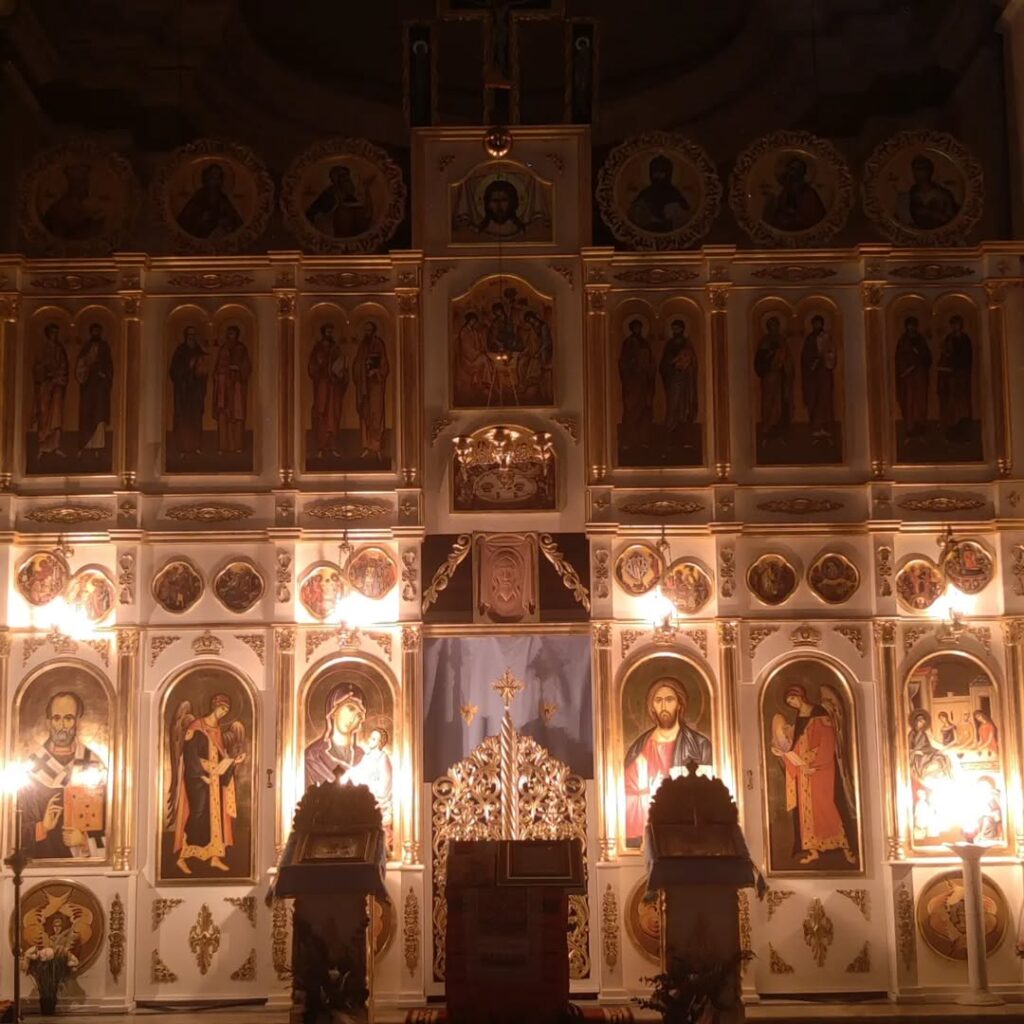
Orthodox services are typically longer than Western Christian services — a full Divine Liturgy on a Sunday morning usually lasts between 1.5 and 2.5 hours. Services are sung or chanted throughout, and they are conducted standing (though some churches provide seating for those who need it). The liturgy is deeply ceremonial, with incense, candles, beautiful vestments, and the opening and closing of the Royal Doors in the iconostasis — the ornate screen of icons that separates the nave from the sanctuary.
What to Wear
Orthodox churches expect modest dress. Women are often expected to cover their heads with a scarf (headscarves are usually available at the entrance). Shoulders and knees should be covered. Men should not wear shorts or sleeveless tops. Avoid wearing strong perfume, as the incense already creates a rich sensory atmosphere.
Participation and Communion
Non-Orthodox visitors are warmly welcome to attend services and to observe. However, Orthodox Holy Communion (the Eucharist) is generally reserved for baptised, chrismated members of the Orthodox Church who have prepared properly. If you are not Orthodox, you can receive the antidoron (blessed bread) that is distributed at the end of the service to all present.
Photography
Always ask before taking photographs inside an Orthodox church. During services, photography is generally not appropriate. Outside service times, many churches welcome respectful photography of their icons and architecture.
Conclusion: A Living Tradition in the Heart of the Mediterranean
Eastern Orthodoxy in Malta is a remarkable story of continuity and change, of ancient roots and modern growth. From the Byzantine-era church communities that predate the Arab invasion of 869 AD, to the Greek merchants of the Hospitaller era who built the Church of St Nicholas in 1569, to the vibrant Romanian, Serbian, Russian, Ukrainian, Bulgarian, and other Orthodox communities of the 21st century — Orthodoxy has been part of Malta’s religious fabric for over a millennium.
The establishment of the Holy Patriarchal Exarchate of Malta in 2021 and the historic visit of the Ecumenical Patriarch in 2022 are powerful signs that this ancient tradition is not only surviving but thriving on this small Mediterranean island. The 16,457 Orthodox believers recorded in the 2021 census represent a community that is young, growing, diverse, and deeply committed to its faith.
Whether you are an Orthodox Christian visiting Malta in search of a spiritual home away from home, a curious traveller keen to explore the island’s extraordinary religious heritage, or simply someone interested in the long and fascinating story of Christianity in the Mediterranean — the Orthodox churches of Malta have much to offer. Their doors, and their hearts, are open.
“In Malta, East and West do not merely coexist — they collaborate, worship side by side, and bear witness together to an ancient and living faith.”
Quick Reference: Orthodox Churches in Malta
| Church | Address & Key Info |
| Community | Location | Services | Jurisdiction |
| Greek/Ukrainian (St Nicholas) | Merchants St, Valletta | Sat 18:00; Sun 09:00/10:00 | Ecumenical Patriarchate |
| Greek (St George) | 83 Merchants St, Valletta | Last Sunday monthly | Ecumenical Patriarchate |
| Romanian (St Roque) | 107 St Ursula St, Valletta | Wed, Fri & Sunday | Romanian Patriarchate |
| Serbian | 32 Eucharistic Congress St, Mosta | Contact parish | Serbian Eparchy |
| Russian (St Paul) | Our Lady of Damascus, Archbishop St | Contact parish | Moscow Patriarchate |